
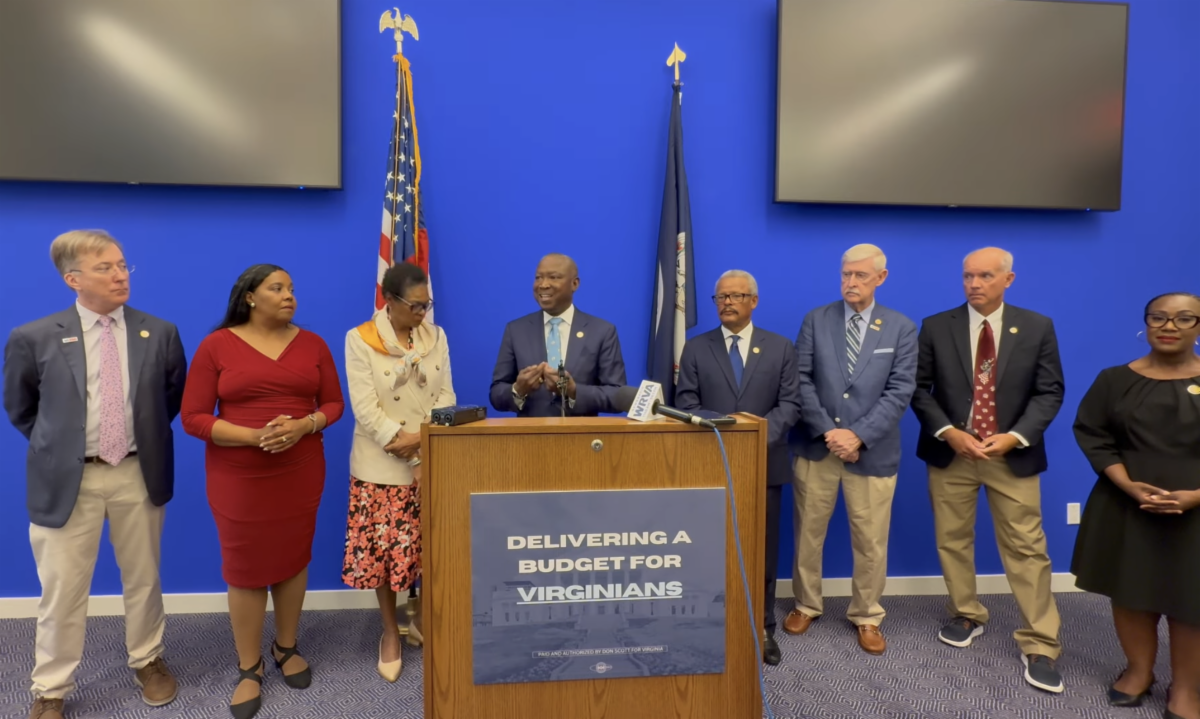
RICHMOND, VA – Today, House Speaker Don Scott and Appropriations Chair Luke Torian introduced the House’s compromise budget proposal. With a focus on lowering costs for working families and closing funding gaps left open by federal funding cuts – this is a fiscally responsible, structurally balanced and bipartisan budget.
“Virginia’s families cannot wait – and we will not make them wait,” said Speaker Scott. “This budget is our promise kept. To the teacher. The trooper. The firefighter. The parent, just trying to make ends meet. With this budget, we are building the place we all know Virginia can be – and has always been destined to be. The best place to live, to work, to play, and to raise a family.”
“This budget comes through for Virginians in a real and meaningful way without introducing a single new tax,” said Chairman Torian. “It anticipates future federal funding cuts by establishing a reserve – so when Washington turns its back again on Virginians we are prepared to step in.”
The full press conference can be viewed at https://www.youtube.com/watch?v=dekJI2MrHIs.
 |
Summary of Major Items in House Conference Proposal:
Executive Summary and Resources
- Proposed compromise package fully funds mandated activities and legislative priorities over the course of the biennium without relying on new tax revenue while maintaining a structurally balanced budget
- Spending initiatives focus on improving affordability for Virginians with resources dedicated to health insurance through ACA premium assistance and Medicaid, to childcare through the subsidy program and a new employer matching model, to food assistance through the SNAP program, and to increasing the minimum wage for Virginia workers
- Exceeds both Senate and House resource levels
Data Center Accountability
- House remains committed to addressing concerns related to data center impacts on Virginia’s energy use, environment, communities, and revenue streams
- The package includes explicit direction for the establishment of a Commission to thoroughly evaluate the direct and indirect costs and benefits of the data center industry, with a report and recommendations for legislative bill and budgetary changes to address financial, energy, and air/ water/noise impacts in time for consideration by the 2027 General Assembly
- Commission will ensure energy demands generated by data centers are not borne by residential rate payers
- Commission will investigate all elements of data center impacts, including community benefits agreements
- Need to consider the importance of the data center industry to revenue streams for local governments – including those with large industry presence, and those interested in attracting future development
- Commission will understand the potential strategies for generating additional state revenue from the industry for future biennia
- The final report would be due on November 1, 2026
Other Key Financial Provisions
- Includes a $225 million deposit to the Federal Uncertainty Contingency Fund that was established in the House budget. These resources will be available to address any further federal retrenchment, as well as to mitigate forecast adjustments for Medicaid and the ACA premium assistance program
- Language is included in Part 5 of the budget authorizing referenda (beginning November 3, 2026) for the local option 1% sales tax for school construction. Language authorizes jurisdictions in PDC 8 to utilize these funds for transportation or school construction to address public transit needs in that region
- Expenditures in this budget are supported by annual revenue collections, meaning the budget is structurally balanced in each year of the biennium while not utilizing one-time carryforwards for ongoing activities
- Budget leaves unappropriated balance of almost $600 million at close of biennium
Public Education
- In addition to the historic $2.6 billion increase in public education funding provided during 2024-2026 biennium, provides a total of $1.8 billion in additional state support over the upcoming 2026-2028 biennium
- This represents $106.2 million more general fund spending than the House’s original budget
- Includes $449.8 million to fully fund rebenchmarking the cost of public education for the new biennium, including updates for enrollment and recognizing ongoing costs
- Honors the value of our education workforce by providing $560.3 million for the state’s share of 3% raises in each fiscal year (as proposed by the Senate) This is in addition to the $117.6 million provided in the caboose bill for the state’s share of a $1,500 per position bonus, which school divisions may opt to deploy in fiscal year 2027
- Enhances funding for students with disabilities through two actions:
- Special Education Add-On. Provides $148.4 million to more than double the add-on established during the 2025 session in response to the Joint Subcommittee on K-12 funding. The add-on expands per-pupil funding for special education students with greater needs (House priority)
- Support for Students with Intense Support Needs Application (SISNA). Includes $10.0 million in FY 2027 to expand student eligibility for SISNA funding, which supports students with the most complex needs, some of the same students that typically are referred to Children’s Services Act private day school placements
- Includes a $98.4 million one-time supplement to the At-Risk Add-On for school divisions to address their specific local operating or capital needs throughout the biennium (Senate priority)
- Since the release of JLARC’s report on K-12 funding, At-Risk support has increased threefold, from $336.4 million in FY 2023 to $993.6 million proposed for FY 2027. This one-time support allows school divisions to access additional funds while the Joint Subcommittee evaluates ongoing funding needs for underserved students
- Provides $17.6 million as proposed in the Senate budget to increase reimbursement rates provided for school breakfast and to encourage more school divisions to participate in the Community Eligibility Provision to provide free meals for all students
- Updates distribution of K-12 sales tax revenues, resulting in a net $17.6 million increase for school divisions
- Provides $1.25 million for the Joint Subcommittee on Elementary and Secondary Education Funding to complete its review of Virginia’s K-12 funding formula
- Provides an additional $299.0 million for school construction grants as proposed by the Senate, bringing the total amount available over the biennium to $519.0 million
Early Childhood
- Increases general fund support for the childcare subsidy program by $137.6 million, for a total of $577 million over the biennium. To put this into perspective, prior to fiscal year 2024, no general fund support was provided for childcare – the only support came through federal funding
- Our proposal includes $25 million to partner with private sector employers choosing to offer childcare as an employee benefit. Not only is it important that our children have quality care; employers benefit when childcare is not a barrier to hiring employees
Higher Education
- Since 2019, because of General Assembly efforts to prioritize GF support for higher education, average tuition costs, in constant dollar terms, have dropped nearly 11% at our four-year institutions and about 15% at our community colleges
- This compromise budget would provide $346.1 million in increased biennial funding for higher education over the 2026 base budget. This package includes funding for both bodies’ priorities, and is above proposals contained in either the House or Senate budgets
- $190.9 million of the funding is provided to maintain affordable access for in state undergraduates, with $121.3 million in increased operating support and $69.6 million for financial aid at public institutions and TAG grants at eligible Virginia private institutions
- $50.0 million is designated to support HBCUs in a public-private partnership to improve health outcomes of vulnerable and marginalized populations in their surrounding localities through research, education, workforce development and outreach
- $20.6 million is provided to support healthcare initiatives at JMU, UMW, Radford and Virginia Tech to increase the number of nurses and doctors
- $43.8 million is designated for the community colleges to expand career technical education and workforce credential programs in healthcare and high demand trades
Labor and Commerce
- Spending in labor and commerce is higher than levels in either House or Senate budget, encompassing all the priorities of both bodies in some fashion
- Housing. Our budget invests an additional $76.5 million over the biennium to help Virginians facing housing insecurity and increase the supply of affordable housing in the Commonwealth
- We invest $25 million to launch a two-year pilot program to generate the development of mixed-income housing across the state
- Our budget invests an additional $20 million in the Virginia Housing Trust Fund, which offers loans for low-income housing projects and provides grants to response organizations serving homeless Virginians, bringing total support to $195 million over the biennium
- Our budget adds $14 million over the biennium to support rapid rehousing efforts and organizational capacity for Continuum of Care lead agencies that work directly to reduce homelessness in the state
- We are also helping citizens facing eviction with rental assistance through the Virginia Eviction Reduction Program with $11.5 million in new resources for this program, bringing total funding to $18.5 million over the biennium
- Virginia’s Workers. The budget includes multiple initiatives to improve the lives of working Virginians, including increasing the minimum wage, requiring employers to offer paid sick leave to employees, and supporting the development of a paid family and medical leave program
- Budget supports the costs of an increase in the minimum wage to $13.75 an hour on January 1, 2027 (legislation increases it to $15.00 an hour as of January 1, 2028) and stronger paid sick leave policy (1 hour of sick leave for every 30 hours of work)
- Budget authorizes a Treasury loan to create a Paid Family Medical Leave Program to allow Virginia’s workers to take time off after the birth of a child or to care for a loved one
- Our budget invests $10.1 million over the biennium in new resources in the Department of Labor and Industry to expand the state’s labor law enforcement and protect our workers
Health and Human Resources
- Across the Secretarial area, this compromise proposal provides more funding than either the House or Senate budgets. In total, the package reflects increases of $3.1 billion in health and human services
- As both budgets did, provides a net increase of $2.4 billion GF to fully fund the Medicaid and CHIP forecasts
- Provides $136.1 million to fund caseload and cost increases in the Children’s Services Act
- Provides $152.7 million to fund increase in SNAP administrative costs (including local costs as funded in House budget)
- Adds $135.0 million to fund new cost share in SNAP benefit allotments (Senate figure, assumes error rate will drop below 10%)
- Provides $81.7 million GF to increase Developmental Disability Waiver rates. This reflects increases for all DD waiver services contained in the DOJ settlement agreement. This includes the 4 additional services that had been funded only in the Senate budget
- Provides $79.1 million in premium assistance for those purchasing health insurance on the state’s health insurance exchange who are losing premium tax credits
- Targeted at those with incomes between 138% and 200% of the federal poverty level
- Also includes language allowing the use of monies in the federal contingency fund if the calculation changes and additional funding is needed for this population
- Provides $44.3 million to increase rates for personal care providers to meet minimum wage requirements beginning January 1, 2028. This reflects Senate position – House funding had been limited to minimum wage impact for consumer directed providers
- Adds $39.0 million GF to partially restore proposed cuts to Medicaid and the CHIP programs
- Fully restores prenatal and postpartum coverage for pregnant women ▪ Partially restores Applied Behavioral Analysis (ABA) for children ages 0-5 (House initiative)
- Does not assume savings from the 340B program (would have affected hospital pharmacy costs)
- Adds $50.0 million in grants to localities for critical drinking water projects (Senate)
- Mitigates reductions in core public health services by adding $43.1 million, including $13.2 million for Ryan White Act Part B Program funding. This represents the higher restorations included in the House budget
- Provides $11.3 million GF for critical services to address Sickle Cell Disease
- Invests an additional $13.8 million for safety net services provided by Virginia’s free clinics and community healthcare clinics
- Includes an additional $3.6 million each year to expanding funding for Marcus Alert Programs
- Includes $3.0 million to increase support for staffing at local departments of social services to meet increased federal requirements (new)
- Adds $3.0 million to connect individuals newly subject to SNAP or Medicaid work requirements to qualifying employment or volunteer activities and resources (new)
Natural Resources
The amendment package includes several major spending items identified as priorities by both the House and Senate. These include:
- $329.5 million GF for the state share of wastewater improvement projects, an increase of $189 million GF over the amount included in the introduced budget
- $294.5 million for deposit in the Water Quality Improvement Fund to support Ag BMPs, which fully funds the needs assessment for FY 2027, and reflects a deposit above both the House and Senate budget levels
- $50.0 million GF for the ongoing costs of the Richmond CSO project
- $43.5 million GF for the Stormwater Local Assistance Fund to support stormwater improvements
- $25.0 million GF to support Soil and Water Conservation District dam repairs and improvements (Senate)
- $10.6 million GF to support response and remediation activities at Shoosmith Landfill in Chesterfield County (new)
- $7.7 million GF for all historic and cultural sites included in the House and Senate budgets
Public Safety
Provides new funding to support necessary agency cost drivers as well as supporting several House and Senate priorities. These include:
- $81.1 million GF in additional funding over the biennium to address operational and personnel costs at the Department of State Police
- $59.7 million GF in additional funding over the biennium to support inmate medical services at the Department of Corrections
- $22.5 million GF over the biennium to support expansion of the Safer Communities Program to the cities of Danville, Hampton, Hopewell, Newport News, and Petersburg
- $8.2 million GF for one-time $1,000 bonuses for correctional facilities staff at the Department of Corrections and Department of Juvenile Justice (Senate)
- $8.0 million GF over the biennium to support a firefighter cancer screening grant program (even higher than House level)
- $6.0 million GF to backfill reductions in federal support for Sexual and Domestic Violence Victim Programs (House)
- $4.8 million GF over the biennium to increase support for the Court Appointed Special Advocates program for the first time since FY 2008 (Both)
Capital
- $2.3 billion in general fund resources ($1.3 billion GF cash and $1.0 billion in GF supported debt) plus another $850 million in NGF appropriation to support state owned buildings
- Focus on renovation or replacement of existing infrastructure while also capitalizing on workforce and economic development opportunities
- Restores capital projects vetoed by Governor Youngkin in 2025 ▪ Priority higher education projects include:
- Replacement School of Dentistry Building for VCU
- Center for the Arts for UVA in Charlottesville (Senate)
- Replacement Courts Building for the Virginia Supreme Court and Court of Appeals
- Engineering and Arts Building at ODU
- Expansion of the VT-Carilion School of Medicine & Fralin Biomedical Research Institute in Roanoke
- Acquisition of the Altria Building in Richmond for VCU- avoids an estimated $1 billion in otherwise needed renovation/construction costs (House)
- Renovation of Virginia Hall at VSU
- Priority state projects include:
- State Military Training and Operations Center for DMA (new) ▪ Funding to address deferred maintenance at DBHDS facilities and within state parks
- Phase 1 installment to provide air conditioning in state prisons (House) ▪ Continuation of legislative priority for a new state agency building in the seat of government
- $400 million for maintenance reserve to continue targeted effort to enhance ongoing upkeep of state-owned facilities
General Government
- $67.9 million for debt service payments owed on bond issuances
- $75.7 million to enhance judicial system processes, to include $40.8 million for deposit to the Criminal Fund to support court-appointed attorney pay and other critical court support costs, $6.5 million to increase rates paid to guardians ad litem, $14.5 million to fund critical court IT initiatives, and $13.9 million for additional judgeships and to address indigent defender paralegal pay
- Includes four new appellate court judgeships as well as 6 new Circuit/District and JDR judgeships
- Over $4 million for local constitutional officers, to include funding for commonwealth’s attorneys to fully address underfunded positions and increase paralegal salaries
- $13.1 million for statewide offices, including $10.7 million for the OAG to provide compression pay and establish a federal litigation unit and $2.4 million for supplemental staffing for the Governor’s office
- $1.7 million to remove confederate statues on Capitol Square
Employee Compensation and Benefits
- Includes $348.0 million GF in FY 2027 and $785.9 million in FY 2028 to fund a 3% salary increase near the beginning of each fiscal year for State employees, State supported local employees and SOQ-funded positions (combining priorities of both bodies)
- Provides $367.7 million general fund over the biennium to replenish the cash balances in the State Employee Health Insurance Fund
- $80 million general fund lump sum deposit at the beginning of the biennium
- Funding to support a 17% premium increase in FY 2027 and 5% in FY 2028
- $80 million general fund lump sum deposit at the beginning of the biennium
Transportation
- Includes $153 million general fund in additional operating support for the Washington Metropolitan Area Transit Authority over the biennium
Other Resource Adjustments/Unappropriated Balance
- The unappropriated balance at the close of the biennium would be $582 million, ensuring sufficient resources are available to address any consequences of any potential economic headwinds